Jam'iya
Rotating savings circle (jam'iya): how to organize one and assign turns
A jam'iya is one of the oldest ways families, friends, and coworkers save together: everyone pays a fixed amount each month, and each month one person takes the whole pot. The idea is simple, but whether it works depends on organization and clear agreements from day one.
Economists call it a rotating savings and credit association, or ROSCA, and it exists under different names in many countries. In Kuwait and the Gulf, it's the jam'iya, and it usually runs on trust with no formal paperwork. That's exactly where most problems start: not with the idea, but with the lack of structure.
How a jam'iya works
- Members: a group that trusts each other. The number of members sets how many months the jam'iya runs.
- Share: a fixed amount every member pays each month.
- Turn: each month, one member receives the full pot.
- Organizer: the person who tracks payments and turns and keeps in touch with members.
Example: 10 members × KWD 100
Take a jam'iya with 10 members, each paying KWD 100.000 a month. Every month, KWD 1,000.000 is collected and goes to whoever's turn it is. The jam'iya runs 10 months, and by the end every member has paid KWD 1,000.000 and received KWD 1,000.000 once. Nobody gains or loses on paper; the only difference is timing.
- The first turn receives KWD 1,000.000 after paying just 100.000, then pays the rest over 9 months. It works like getting the money up front.
- The last turn pays for 10 months and receives in month 10. It works like committed savings.
How to choose turns
There's no single right way. What matters is that everyone knows the method and agrees to it before the first payment:
- By need: someone with a known expense (a wedding, tuition, travel) takes the turn closest to it.
- By draw: the fairest option when everyone wants the same months.
- Organizer first: many jam'iyas give the organizer the first turn, since they carry the follow-up.
- Swaps: agree on whether two members can trade turns, and who has to approve it.
Rules to agree on up front
Most jam'iya disputes come from a situation nobody planned for. Write these points down and make sure everyone has seen them:
- Payment date: a set day each month, ideally after most members get paid.
- Late payments: how many days of grace? Who contacts the late member? Does the payout wait until every share is in?
- Someone leaves: must they find a replacement to take their seat? If they've already had their turn, how do they finish what they owe?
- How to pay: a transfer straight to the person whose turn it is, or to the organizer, with proof for every transfer.
- Communication: where reminders and updates go, so they don't get lost in a busy chat.
Put your jam'iya share in your budget as a fixed commitment from month one, and keep it there after your turn. Many people struggle with payments after their payout because they spent it like extra income.
Keeping records: who paid and who received
A clear record protects both the jam'iya and the relationships. For every month you should know whose turn it is, who has paid, who hasn't, and whether the payout was received. For building a full table, see jam'iya schedule.
Your jam'iya in Mastoora
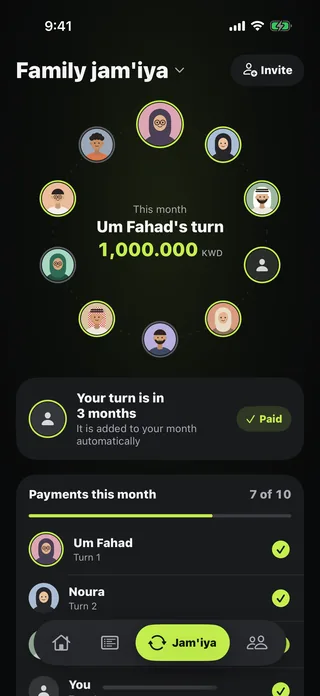
Jam'iya in Mastoora keeps that whole record in one place: tap "Start a jam'iya," enter the name and monthly share, and put members in turn order, including people without the app, whom you add by name. Then send the invite link. Each member sees their turn and marks their own payment, and the organizer can mark everyone's and send "Remind the rest" to whoever hasn't paid.
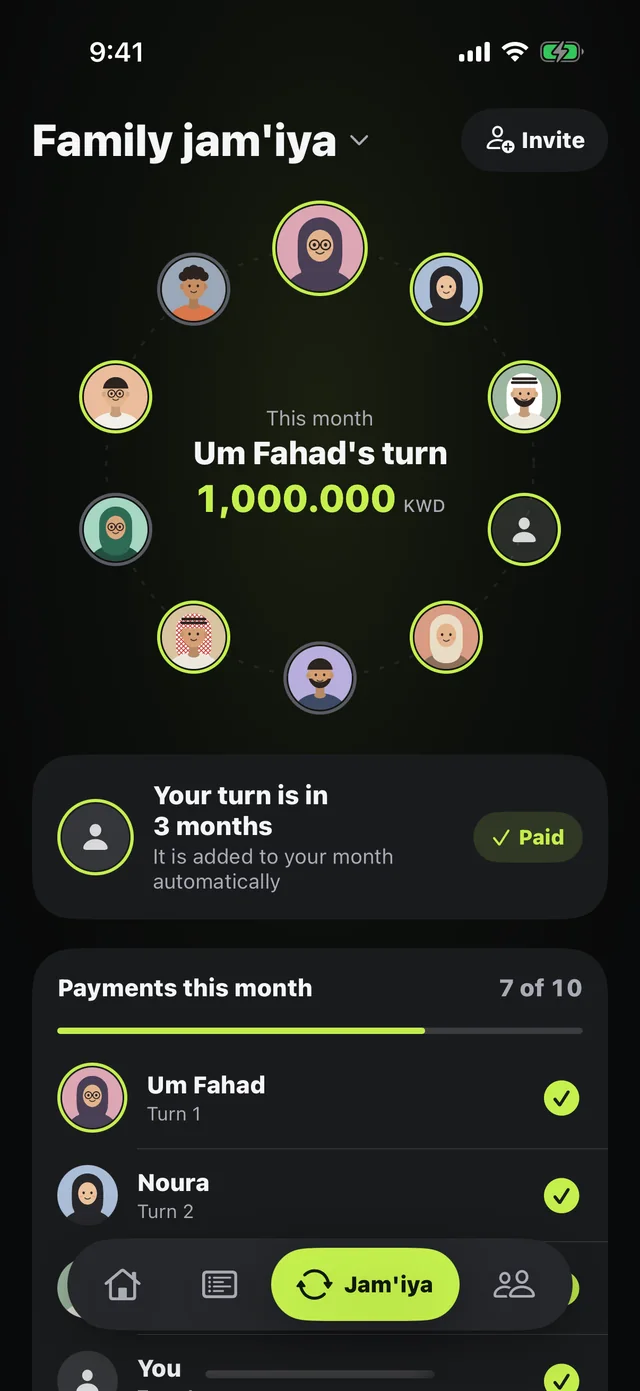
Mastoora never holds or moves any money. The money moves between you the way it always has; the app only organizes. And your monthly share is counted automatically in your daily spending limit.

Try Mastoora free
Add your commitments once, and Mastoora tells you every day what you can spend.
Download on the App StoreThis article is general information, not financial advice.
Frequently asked questions
How many members should a jam'iya have?+
It depends on how long you want it to run, since each member adds a month. Smaller jam'iyas are easier to track, while larger ones mean a longer wait for the last turns.
What if a member pays late?+
Go back to the rule you agreed on: the grace period and who reaches out. An early, friendly reminder solves most cases before they grow.
Does Mastoora hold the jam'iya money?+
No. Mastoora only organizes turns and payments; transfers happen directly between members.