Salary & budget
How to split your paycheck in four steps
Payday comes, and two weeks later you can't tell where the money went. The fix isn't to deprive yourself; it's to split your salary in a clear order from day one. Here are four steps with a worked example.
The order matters: commitments first, then savings, then variable spending. Most people do the opposite: they spend first and save whatever's left, and usually nothing is left.
Step 1: List all your fixed commitments
A fixed commitment is any amount that's withdrawn or paid every month at a roughly known value. Put them all on one list with their due days:
- Fixed bills: rent, electricity and water, internet, and your cell phone plan.
- Installments: the car, a loan, and buy now, pay later purchases.
- Subscriptions: streaming, music, cloud storage, and the gym.
- Jam'iyas: your monthly share in any jam'iya you're part of.
Step 2: Pay yourself first on payday
Pick a fixed savings rate, say 10% to start, and move it to a separate account on payday itself. That turns saving into a commitment like rent, not something you do "if anything's left."
Step 3: Set a budget for variable spending
What remains after commitments and savings is your variable budget: groceries, gas, restaurants, coffee, shopping, and outings. You don't need twenty categories; one number is enough.
Step 4: Divide it by the days
A monthly number like 240 KWD feels big in the first week and then disappears. Divide it by the days in your pay cycle, and it becomes a daily number that's easy to stick to.
| Item | Amount (KWD) |
|---|---|
| Salary | 900.000 |
| Rent | −300.000 |
| Car installment | −120.000 |
| Phone and internet | −25.000 |
| Electricity and water | −15.000 |
| Subscriptions | −10.000 |
| Jam'iya share | −100.000 |
| Savings (10%) | −90.000 |
| Left for variable spending | 240.000 |
| ÷ 30 days = today's allowance | 8.000 |
Commitments add up to 570 KWD and savings to 90, leaving 240 for variable spending, or 8 KWD a day. Spend 5 today, and you have 3 extra tomorrow.
If the daily number looks too small, don't cut savings first. Review your commitments: a subscription you don't use, or a jam'iya share bigger than you can handle. Every dinar you cut from commitments raises your daily allowance for the whole cycle.
Count the days from payday to the next payday, not from the 1st of the month. That's the stretch your money actually has to last.
How Mastoora helps you split your salary
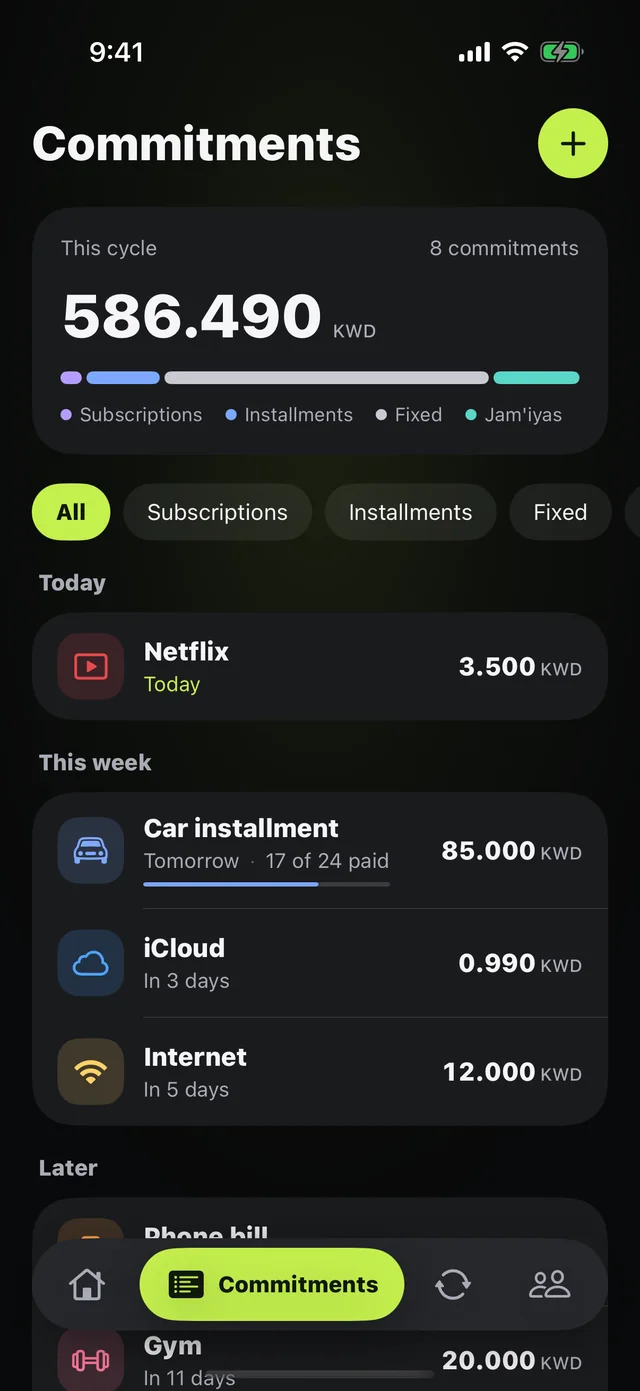
In Mastoora, you add your commitments once in Commitments, across four kinds: subscriptions, installments, fixed bills, and jam'iyas, with ready prices for popular services. The app takes them out of your salary and shows the month's total and what's coming up.
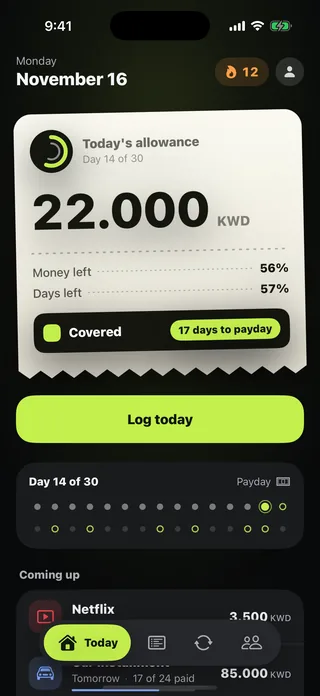
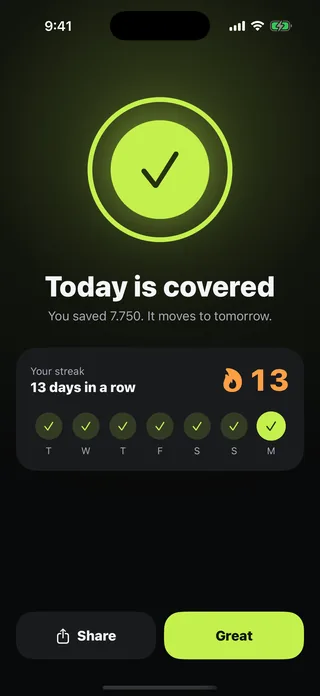
Then it divides the rest by the days until payday and gives you "Today's allowance", and you log your day's total at night in seconds. To choose your percentages, read about the 50/30/20 rule.

Try Mastoora free
Add your commitments once, and Mastoora tells you every day what you can spend.
Download on the App StoreThis article is general information, not financial advice.
Frequently asked questions
How much of my salary should I save?+
Start with a rate you can keep every month, like 10%, and raise it gradually. Consistency matters more than the number.
What if my commitments eat most of my salary?+
Review subscriptions and installments first, since they're the easiest to cut. Read how to track your subscriptions.
Should I always divide variable spending by 30 days?+
Divide it by the actual number of days until your next payday, which could be 28 or 31.