Salary & budget
Paycheck to paycheck budget: make your salary last until payday
"My salary doesn't last until the end of the month" is something a lot of us say, and sometimes the problem isn't the salary at all. It's the calendar. If your salary lands on the 25th and you budget from the 1st, you're planning for a month you don't actually live.
A traditional monthly budget assumes money comes in at the start of the month and goes out over it. But in Kuwait and across the Gulf, many salaries land near the end of the month or on another fixed day, and commitments have dates of their own. When those dates get mixed up, the totals come out wrong even if every individual number is right.
Why the calendar month breaks your budget
- Your salary arrives days before "the month": the October 25 salary is what you live on until November 24, but a calendar budget counts it toward October, which has only 6 days left.
- Spending clusters at the start: as soon as the salary lands, postponed purchases and outings pile up, and a big share is gone before the 1st.
- Commitments leave on scattered dates: an installment on the 27th, a subscription on the 3rd, a bill on the 10th. If they aren't tied to your pay cycle, you never know what's really left.
- "Days left in the month" is misleading: on the 20th, the calendar says 10 days are left, while you actually have 4 days until payday, or 34, depending on which salary you mean.
The fix: your month starts on payday
A payday-to-payday budget means your financial cycle starts the day your salary lands and ends the day before the next one. Every calculation (commitments, spending, days left) follows that cycle, not the calendar.
| Date | Event | Amount (KWD) |
|---|---|---|
| October 25 | Salary lands | +1,250.000 |
| October 27 | Car installment | −210.000 |
| November 1 | Rent or housing installment | −300.000 |
| November 3 | Subscriptions | −11.490 |
| November 10 | Phone bill | −15.000 |
| November 15 | Jam'iya share | −50.000 |
| October 25 – November 24 | Left for daily spending (31 days) | 663.510 |
This way you see the whole picture from day one: KWD 586.490 is set aside for commitments and KWD 663.510 is for daily spending, or about KWD 21.400 a day over 31 days.
The last-week squeeze: where it comes from
The week before payday doesn't get hard out of nowhere. It's the result of early weeks that quietly took more than their share. Spend KWD 30 a day for the first 10 days instead of 21.400, and you've borrowed about KWD 86 from the end of the cycle. That money comes back to you as "my salary isn't enough."
Measure yourself by percentage, not amount. If half the cycle has passed and you have less than half your free money left, cut back now, while you still have enough days to correct course.
Practical steps to end the end-of-month crunch
- Set your payday as the start of your cycle, even if it's the 25th or the 27th.
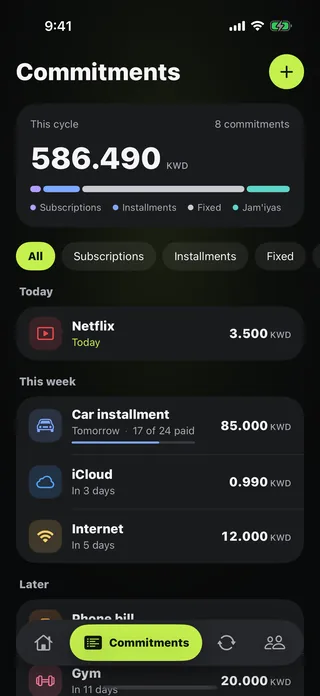
- List every commitment that leaves within the cycle, including small subscriptions and your jam'iya share.
- Subtract them as soon as your salary lands, and treat what's left as all you have.
- Divide the rest by the days in the cycle to get a clear daily spending limit.
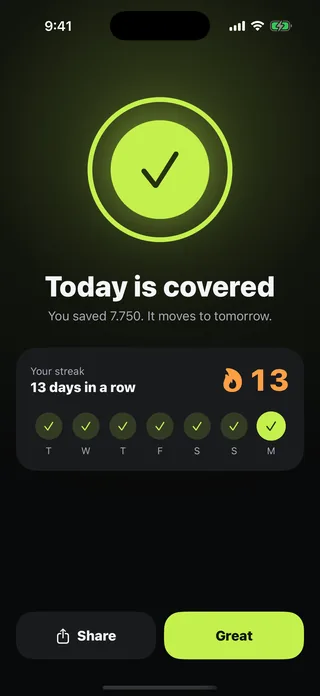
- Check in every night: spent less? Let the difference roll to tomorrow. Spent more? Take it off tomorrow instead of leaving it for the last week.
- Save before you spend: if you want to put away a fixed amount, add it as a commitment at the start of the cycle. For a full breakdown, see monthly budget.
Mastoora is built on the payday cycle
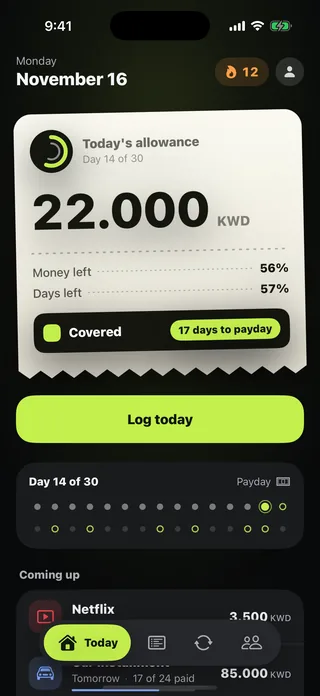
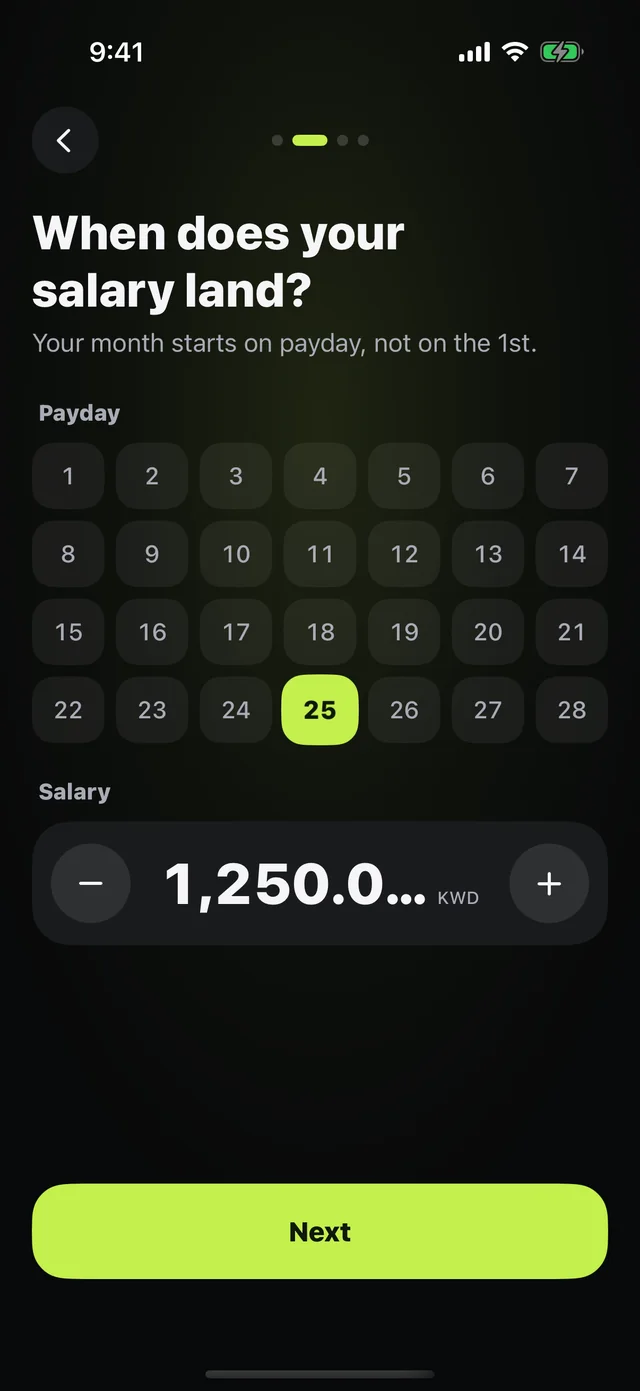
Mastoora doesn't really know "the 1st of the month." From the moment you open it, it asks when your salary lands and how much it is, then builds everything on your payday cycle: Commitments are counted in the right cycle, the countdown to payday is always in front of you, and when payday comes, a new cycle with a fresh allowance starts automatically.

Try Mastoora free
Add your commitments once, and Mastoora tells you every day what you can spend.
Download on the App StoreThis article is general information, not financial advice.
Frequently asked questions
My payday changes every month. What should I do?+
Use the closest day and adjust the start of your cycle whenever the date moves. What matters is that the cycle starts when the money actually arrives.
How do I know my problem is timing and not my salary?+
If there's a reasonable amount left for spending after commitments and you still run out before payday, the issue is usually how spending is spread across the days, not the size of the salary.
Should my jam'iya share count as a commitment?+
Yes. It's a fixed amount that leaves every month, so treat it like any other installment and subtract it before working out your daily spending.